
The Mixer
By Lee Ann Farmer
It’s funny how things suddenly become meaningful right when you have to let them go. My parents’ house is living proof, and it’s really getting to me. I guess it’s my house too, in the sense I grew up there from the age of ten. My brother from the age of thirteen. It’s the house that holds fifty-two years of our family history, a giant brick storage bin of memories, that, like Pandora’s box, has opened and given life to long forgotten feelings.
Right now, the house is being staged for an estate sale. Every cupboard and drawer have been opened, inspected, and emptied. The contents have been carefully cleaned and laid out on tables. Much has been thrown away. You name it, we found it. Fondue pots, figurines, decaying rubber bands, and more candlesticks than Notre Dame Cathedral on any given Sunday. The house is crammed with a life’s worth of treasures, all too special to part with, it seems. And it is up to my husband, my brother, and me to sort through it and get the house ready to sell.
My mother died two years ago, and we moved Dad to a dementia care home last September. We were blessed to have the luxury of time when it came to the house, but now the time has come.
Closing up shop is painful. It was a reasonably happy house. Just because we know it’s the right decision doesn’t make it easy. I see my mother’s influence on every bookshelf, on every end table, and then I see me, stripping away her dreams of the perfect family home. My dad lived there too, of course, but this is Mom’s house all the way. As I finger the embroidered linens, I keep asking her if it’s OK to part with them, and I apologize to her, over and over. While my brain knows she’s in a better place where things like antique clocks no longer matter, my heart knows that Mom would have been happiest if one of us had wanted to move in and not change a thing.
My parents remodeled their kitchen about fifteen years ago, at which time they would have had to take everything out of the cabinets. That would have been the perfect time to part with, say, the mismatched set of dishes that weren’t being used any more, or the thirty-year-old Cool Whip containers that stood in for Tupperware. But no, everything was put back into the cupboards to be dealt with later. By me.
At first, I was against an estate sale. I didn’t want strangers walking through my parents’ home, commenting on the outdated Early American décor, perhaps being disrespectful, perhaps pawing through Mom’s extensive collection of books and offering $5 for a complete set of Harvard Classics. I knew our neighbors well enough to know they would be itching to get inside and nose around, making lists of things they thought my mom would want them to have. But as we continue to work our way through the closets, we realize this is a much bigger job than we have the time or energy to handle. My husband and I live 2,500 miles away, and my brother runs a business that doesn’t allow much bandwidth for organizing keepsakes. Together, we are losing steam. An estate sale company can come in, do all the work, hand us a check and we could be done with it. It’s the way to go.
Out onto the tables came the crystal, the vases, the pickle platters and candy dishes. And out from under the kitchen counters came the crock pot, the blender, the plastic pitchers, and the mixer.
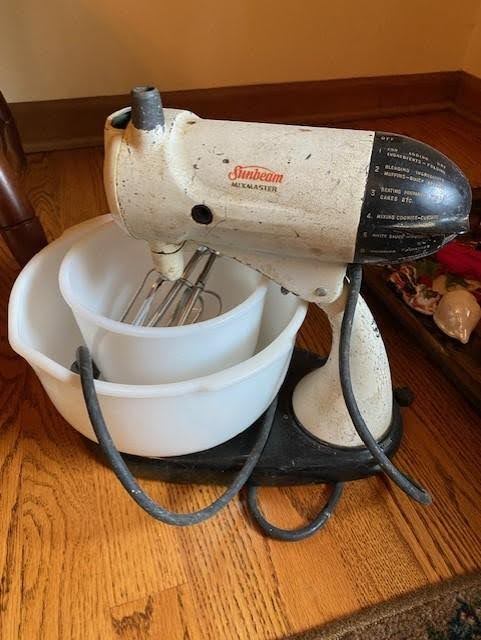
My mother received her Sunbeam Mixmaster as a wedding gift back in 1953. It is white with a black dial on the right-hand side where you change the speeds from slow for adding dry ingredients to fast for beating eggs or icings. There are two white glass bowls, one large and one medium sized. How they survived sixty-seven years of marriage, two kids, countless birthday cakes and a move to the suburbs is beyond me, but there they are, the medium sitting inside the large, ready for action. The beaters rest entwined inside the smaller bowl, and the thick black electrical cord is loosely wrapped around the whole thing.
The mixer. Mom’s mixer. Maybe some people cherish objects like jewelry, clothing, or souvenirs from long ago travels. For me, this mixer kind of says it all. It was the workhorse of a common, yet extraordinary woman. One of her trusted allies that helped her shape her chosen destiny of being a very present mother, responsible for feeding her family, day after day after day. Mom was many things, a schoolteacher and a volunteer for any number of worthy causes. She was exceedingly bright and deeply interested in the people and the world around her. Even though she was always busy with projects outside the home, her real fulfillment came from being Mom.
She wasn’t especially known for her baking or cooking but was what I like to call a competent “mom cook.” Mom shouldered the life sentence of figuring out what was for dinner every night of our lives while my brother and I lived under her roof and thereafter for just her and Dad. I can remember sitting at the kitchen table during breakfast and Mom thinking aloud about dinner, asking my opinion on cube steak versus pork chops. I replied with typical teenage indifference, “MOM! I don’t want to think about it. I’m eating breakfast!” She would shoot back, “Well, SOMEBODY has to think about it!” Somebody was unfailingly her.
To be sure, one doesn’t typically use a mixer for weekday dinner prep. The mixer was for special occasions, birthdays, parties, and potlucks. Seeing the mixer out on the counter meant something unusual was going to happen. Mixers are heavy. You don’t get them out from under the counter without a good reason.
Mom’s Mixmaster is no exception. It has to weigh over ten pounds. Mom was a very slight woman, five foot three and shrinking, and on a very good day she might have cracked 100 pounds. Her many physical ailments, including a late in life discovery of Celiac disease, never stood in the way of her dragging out the Mixmaster and hoisting it up to the counter so she could make every celebration special.
When my husband came on the scene some thirty-three years ago, she learned how to make angel food cake, because it was his favorite. She made any number of cookies and brownies for school bake sales. And there was my ultimate favorite thing Mom ever made…sticky buns. Glorious yeast rolls covered in gooey caramel and cinnamon. It took hours for the whole process, from proofing the yeast to mixing the dough, letting it rise, forming the rolls, and baking. The Mixmaster could barely handle the weight of that dough, but it consistently rallied to blend it together. The smell of those rolls in the oven was evidence of heaven here on Earth.
As time went on, the Mixmaster saw the light of day less and less often, but we always knew it was there, and we never doubted that it could rev up and take care of business if called into action. We never thought of it as out of date. It worked every time. There was never a need for a newer, fancier version. The mixer stayed safe in its spot under the counter, over time collecting a few dings and pits in the white paint.
One day, probably about twenty years ago now, Mom and I went to a museum exhibit of the early 20th Century décor and private rooms of a prominent local family. We marveled at the fact that the husband and wife had separate bedrooms. How great would that be? We admired the draperies and upholstery that spoke to the fact that the family had money and lots of it. The living and dining rooms dripped with the opulence of the era, as did the elaborate black and white tiled bathrooms. We turned the last corner to see the kitchen, where the servants prepared the family meals. There, on the counter, was a Sunbeam Mixmaster, just like Mom’s.
“Mom, your mixer is in a MUSEUM!” I laughed.
“Oh, that can’t be the same one. Mine’s not that old,” she countered.
“Mom, yours is from 1953. It can totally be the same one. You own a museum piece!”
We both leaned against the ropes separating us from the display to get a closer look. There was no mistaking it was the same mixer.
I don’t think Mom knew whether she should be embarrassed that her mixer was that old or proud that she had always had a quality kitchen appliance that not only stood the test of time but was endorsed by the upper crust.
Now I look down at the Mixmaster, sitting on the floor between boxes of glassware and placemats. The time has come for it to go to its next home. Sixty-nine years old, and I’m sure if I plugged it in, it would start right up. I might need to nurse the speed dial a bit, and the turntable was always a bit rickety, but I know it would work. It’s tempting to take it home with me, but it’s not practical. I realize I won’t ever know what happens to it. Someone will probably pick it up for a couple of dollars, and who knows what they will do with it? If it doesn’t sell, it will be carted away with other unwanted relics, and this makes me so very sad.
The mixer is emblematic of so many things. Of my mom’s deep and abiding love for family that kept her in that kitchen for so much of her life. Of the time and talents of so many women of her era for whom baking was art, their mode of self-expression. Of the tireless work ethic of those women, who wouldn’t dream of spending money on a newer mixer if the old one still worked.
But mostly, it will always remind me of Mom herself. I’m floored with the guilt of selling Mom’s things and emptying her house, and the equally selfish feelings of resentment at being stuck with the task. The tears come as I’m once again reminded of how much she loved this house and everything in it. And how much she loved us.
I put down the box I’m carrying and sit on the floor next to the Mixmaster. I talk to it for a minute or two, thanking it for its service, and wishing it well on its next journey. I know I’m weird, but in this moment I don’t care. I take pictures of it and promise I will never forget it. And I ask Mom if it is OK to let it go.
I don’t get answers from Mom when I ask these things, but I feel better for at least extending her that courtesy. I hope she knows we’re doing our best, trying to take care of Dad and of all the loose ends that go along with that. Selling the house is a big one. Mom was too sick to get that done before she died, and I promised her I would take care of it. I pull myself up and smile at all the things that I must now commit to memory, knowing I won’t see them again. I hope that somewhere, all her illnesses erased, Mom is smiling back, her mouth crammed full of a fresh, hot sticky bun.
Godspeed Mixmaster. I miss you, Mom.